

Ready for lift off? Next stop, Mars - at least that's been the hype around the latest IPO. SpaceX debuted in the public markets on June 12, 2026, to great fanfare, boasting the largest company valuation to date, exceeding $2 trillion. Elon Musk founded SpaceX in 2002 with the ultimate goal of creating a self-sustaining colony on Mars. So what exactly is SpaceX? It's a conglomeration of three big ideas that have moved from the realm of private investment and into public markets. Before we jump into what SpaceX does, let’s review IPOs.
IPOs
An Initial Public Offering (IPO) is the mechanism that privately held companies go through to be distributed to a wider audience through the publicly traded stock market. The rationale for taking a company public is to offer early investors an opportunity to free some of the funds they invested initially through the liquidity a broad public market offers. It also allows new investors to infuse fresh capital, which supports the growth of enterprise services, innovations, and expand value over time.
Founders and early investors seek to realize return of or growth on their initial capital: through dividend income, business expansion of the company’s value — tangible or perceived — that has been built over its time as a private entity. Enter the IPO.
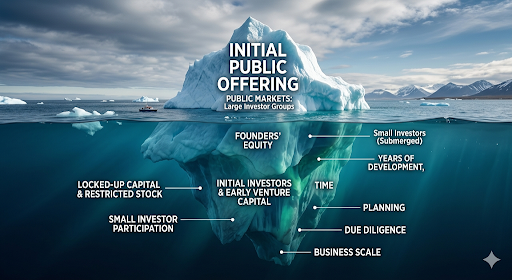
IPOs can look like an iceberg - all you see is a relatively small portion of a massive structure. Under the surface of an IPO is often a great amount of time, human capital investment, risk taking, and adjustments to a business to create value. If the private company can survive long enough and grow large enough, it may achieve the opportunity to be offered to a wider investing audience.
 1
1
IPO of SpaceX
According to an analysis presented by NYU Stern School of Business Professor Aswath Damodaran, SpaceX consists of three loosely connected business segments, each with distinct functions and financial profiles.
The three segments of SpaceX that Professor Damodaran lays out:
- Space Launch Business : Seeks to launch satellites and other cargo into space. Innovation here is the development of reusable rockets, which provides a significant cost advantage over competitors.
- Connectivity Business (Starlink) : Seeks to leverage its ability to launch satellites cheaply, by creating a global broadband internet service. This segment forms the core of SpaceX's revenue, accounting for roughly 60-70% of the total.
- AI Business (xAI/Grok) : Following the acquisition of xAI/Grok, this segment aims to compete in the enterprise AI market, targeting a massive addressable market.
Of note, SpaceX as a whole is losing money, primarily due to high research and development expenses. Other high profile IPOs are expected to come to market later this year and are in a similar position as SpaceX, reliant on the prospects for future growth to justify their current prices or anticipated prices. Essentially, the price of the stock contains big ideas, big personalities and the desire to solve problems we currently face or ones that we perceive are coming.
IPO Expo
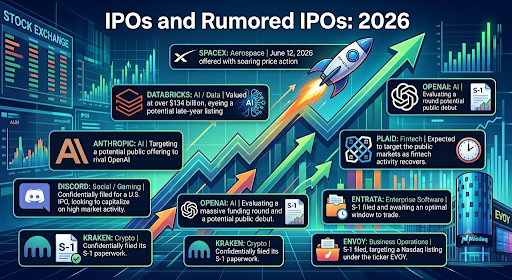
New companies enter publicly traded markets every year. The image below shows a listing of the Top Pending & Rumored IPOs (2026):
 2
2
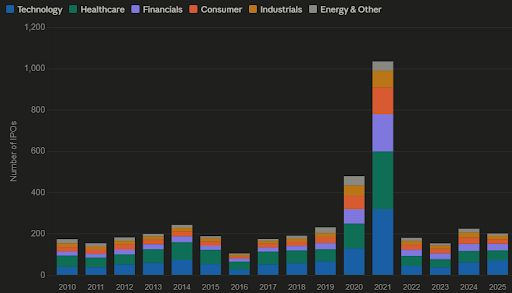
But what does recent history tell us about IPOs? Since 2010, there have been 4,127 IPOs. The figure below shows the number by year and color matched by stock sector.
 3
3
Curb Your Enthusiasm: IPO Hype vs IPO Reality
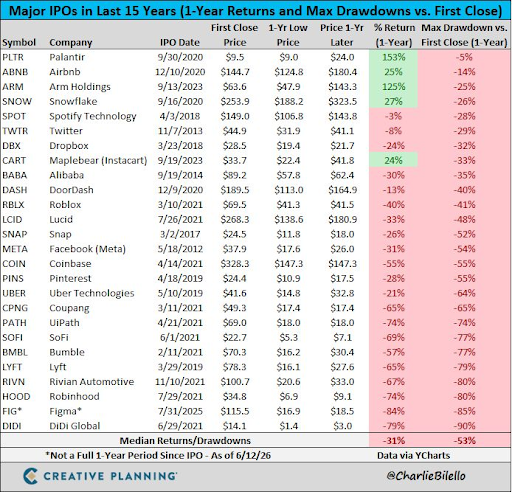
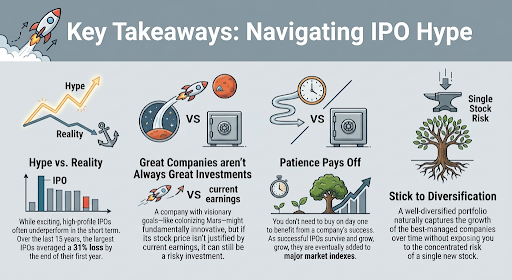
The story around some IPOs is astounding, but the evidence from the average of the largest IPOs in the last 15 years has not always lived up to the hype in the near term. The group average of these stocks have lost -31% after 1 year.
 4
4
Conclusion
In our view, an investor does not have to feel the pressure of being part of an IPO to get a good result long term. A well diversified portfolio has the potential to go to infinity and beyond because a broad diversified portfolio owns a wide number of holdings. Through diversification, you will be the beneficiary of the best ideas and best managed companies that produce goods and services and create economic value for consumers worldwide. In time, the IPOs that survive and thrive are added to diversified indexes.
In summary, a good company may not be a good investment. In evaluating the hype around IPOs like SpaceX, it’s good to keep our feet on the ground and our head out of the clouds. Excitement about the future of colonizing Mars is great, but on this terrestrial ball, if the price isn’t justified by the earnings, then you could be staring into a black hole.
 5
5
______________________________________________________________________________________________________________
Jason Branning is a fee-only, fiduciary advisor with Asset Dedication LLC, DBA Branning Wealth Management. He provides hands-on, practical financial advice for retirees and pre-retirees.
______________________________________________________________________________________________________________
Sources:
1. Lasseter, John, dir. Toy Story. Pixar Animation Studios / Walt Disney Pictures, 1995. Film."To infinity and beyond!" — Buzz Lightyear
2. Figure 1. IPO Iceberg Conceptual Model. Note. Conceptual diagram visualizing an Initial Public Offering structure. Image generated by Google Gemini model on June 22, 2026, in response to the user prompt.
3. Excess Returns. (2026, June 19). The Trillion Dollar Gap | Aswath Damodaran on SpaceX, AI and the Big Market Delusion [Video]. YouTube. https://youtu.be/vWx3kQuBHzE?si=-kmV5OS6LGVfuCNU
4. Google AI. IPOs and Rumored IPOs: 2026. Infographic, June 22, 2026. (Generated in response to user prompt).
5. Chart generated by Claude.ai. Renaissance Capital. "IPO Statistics and Market Insights." Renaissance Capital, 2026, www.renaissancecapital.com/IPO-Center/Stats.U.S. Securities and Exchange Commission. "Statistics for Initial Public Offerings (IPOs)." SEC.gov, 2025, www.sec.gov/data-research/statistics-data-visualizations/initial-public-offerings-ipos.Ritter, Jay R. "Initial Public Offerings: Updated Statistics." University of Florida, Warrington College of Business, 18 May 2026, site.warrington.ufl.edu/ritter/files/IPO-Statistics.pdf.Ernst & Young. "US IPO Market Trends." EY, 2026, www.ey.com/en_us/insights/ipo/ipo-market-trends.Stout. "IPO Trends: A Promising First Half of 2025 and a Cautious Path Forward." Stout, 12 Aug. 2025, www.stout.com/en/insights/article/ipo-trends-promising-first-half-2025-cautious-path-forward.PwC. "US Capital Markets Watch — Q1 2026." PwC, 2026, www.pwc.com/us/en/services/consulting/deals/us-capital-markets-watch.html.
________________________________________________________________________________________________________________________
Disclaimer: This newsletter is distributed for general informational purposes only and is not intended to constitute legal, tax, accounting, or investment advice. No part of this newsletter nor the links contained therein is a solicitation or offer to sell investment advisory services except where applicable in states where we are registered or where an exemption or exclusion from such registration exists.
Information throughout this newsletter is obtained from sources that we believe reliable, but we do not warrant or guarantee the timeliness, accuracy, or completeness of this information, and the information presented should not be relied upon as such.
The investment return and principal value of an investment will fluctuate. All investments involve risk of loss, including the possible loss of all amounts invested, and nothing within this newsletter should be construed as a guarantee of any specific outcome or profit. This newsletter may not be reproduced or redistributed in whole or in part.
Any opinions expressed herein are those of the author and may not reflect the opinion of any affiliates. Furthermore, all opinions are current only as of the date of the distribution to the intended recipient and are subject to change without notice. Branning Wealth Management, LLC does not have any obligation to provide revised opinions in the event of changed circumstances.