

Quick Answer
- Growth investing focuses primarily on building wealth over long horizons.
- Retirement income planning focuses on creating reliable and sustainable income first, then on managing long-term risk.
Growth Investing During Working Years
For most of your working life, growth investing made sense: stay invested, let time absorb the volatility, and let compound returns do the work. A bad year was a setback; you could wait out because you had a paycheck.
Retirement changes the equation. Your paycheck from wages is gone. The moment you start drawing income from your portfolio, you lose the safety nets that made a growth strategy survivable: your paycheck from work and a longer time horizon. A market decline in the early years of retirement isn’t a temporary dip — it can permanently reshape how long your money lasts, regardless of how markets recover afterward.
“Don’t ask the market for permission to retire.”
At Branning Wealth Management, we specialize in the transition from wealth accumulation to retirement income distribution. Here is what that transition actually means.
Two Different Jobs. Two Different Strategies.
Growth investing and retirement income planning are not two points on the same spectrum. They are built around fundamentally different definitions of success.
The Risk That Changes Everything: Sequence of Returns
Sequence-of-returns risk is the danger that poor market returns early in retirement combined with ongoing withdrawals. Without a clear income plan, poor sequences early in retirement can permanently deplete a portfolio, even if later returns are strong. Two retirees can average the same return over 20 years and arrive at completely different outcomes, simply because of when the bad years hit.
This risk doesn’t exist during accumulation. A working investor who experiences a down year waits it out by continuing to buy more shares at cheaper prices. However, a retiree who must sell assets to cover living expenses locks in those losses permanently. The order of returns matters as much as the average.
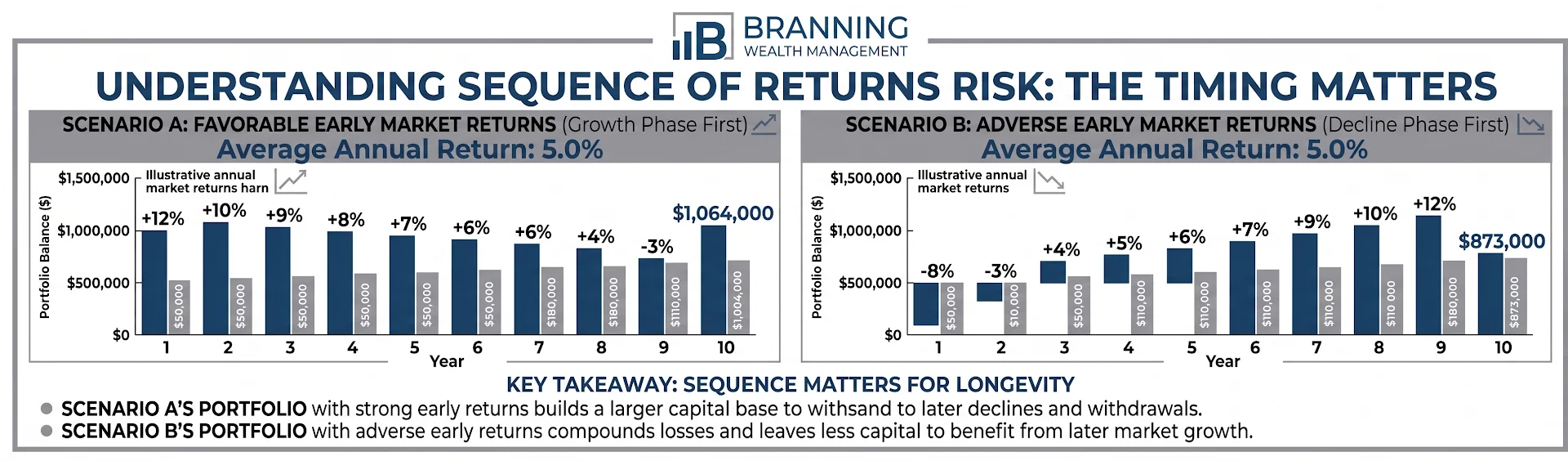
The Safety-First Solution: Build the Income Floor First
Safety-First retirement income planning — grounded in Modern Retirement Theory, co-developed by Jason Branning, CFP®, RICP® and M. Ray Grubbs, Ph.D., and published in The Journal of Financial Planning seeks to address sequence-of-returns risk structurally, not statistically.
Rather than drawing income by selling portfolio assets, our approach seeks to pre-fund your essential living expenses through a bond ladder. A bond ladder is a series of investment grade fixed-income securities that mature on a schedule aligned with your spending needs. When markets decline, your income is already set aside. The goal is for you not to be forced to sell growth assets at the wrong time to pay your bills.
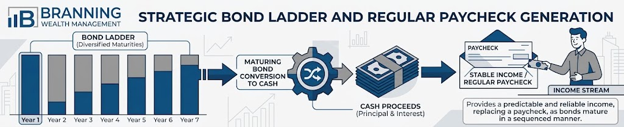
The remainder of your portfolio — freed from funding short-term income — stays invested for long-term growth. Safety-First is not a conservative strategy. It is a structural one.
Quick Answers
What is sequence-of-returns risk?
The danger that withdrawing income during a market downturn early in retirement permanently reduces your portfolio — even if markets recover strongly afterward. The order of returns matters as much as the average return.
What is a bond ladder?
A series of fixed-income securities that mature at scheduled intervals, used to pre-fund essential retirement expenses without selling equities. At Branning Wealth Management, the bond ladder is the typical foundation of every Safety-First income plan.
When should I shift from growth investing to income planning?
Ideally five to ten years before retirement. This is early enough to build the income floor before you need it, and before a market downturn forces the issue. Episode 6 of the Essentials series is about exactly this — what your portfolio is actually supposed to do once you're no longer adding to it from your work paychecks.
If you are facing retirement and want to understand how this framework applies to your situation, we would welcome the conversation.
Schedule a conversation at branwealth.com
Disclosures:
All investing involves risk, including the potential loss of principal invested. This blog is distributed for general informational purposes only and is not intended to constitute legal, tax, accounting, or investment advice. Information in this blog is obtained from sources that we believe reliable, but BWM does not warrant or guarantee the timeliness, accuracy, or completeness of this information. Investment advisory services are offered through Asset Dedication, LLC, an SEC-registered investment advisory firm DBA Branning Wealth Management. Jason Branning, Kelly Jennings, Johnson Rhett, and Kristi Tidwell are investment advisor representatives of Asset Dedication.