
Buying a home is exciting – but it’s also one of the biggest financial decisions you’ll make. It comes with its fair share of stress. You probably feel like there are a million things on your plate during the process.
Suddenly, a simple thought like ‘I want to buy a house’ comes with a flood of questions: How much can I really afford? Is the location convenient for work and family? How’s the neighborhood? What about school districts? Do I need a realtor? How about home inspections – how do those work again?
With so much to consider, here are 7 financial essentials to help protect your budget and future when purchasing a home:
1. Make Sure The Home Purchase Aligns with Your Overall Financial Goals
First and foremost, before you commit, take a step back and ask: “How will this home affect my monthly cash flow, retirement plans, taxes, and overall financial picture? Your home should align with your broader financial goals – not overshadow them.
2. Monthly Payment Amount
Make sure your total monthly payment – including property taxes, homeowners insurance, private mortgage insurance (PMI), and any other ancillary costs – doesn’t exceed 25% of your net household income. That’s a better rule of thumb than the commonly used 32% of gross income. Why? Because everyone’s tax situation is different, and using gross income doesn’t give you a real, apples-to-apples comparison. Using net income figures make the calculations more realistic.
For example, if your net monthly income is $12,000, aim for a total housing payment under $3,000/month.
3. Credit Score
Like it or not, your credit score plays a big role in the homebuying process. It directly affects the interest rate and loan terms lenders will offer you. Before you start shopping for a home, take the time to get your credit in order. Just a 1% difference in your mortgage interest rate – whether it’s a 15- or 30-year loan – can cost you tens of thousands, if not more, over the life of the loan. Know your credit score!
4. Down Payment
While the “20% down payment” rule of thumb gets a lot of attention, it’s not a hard requirement for buying a home. That said, having a solid chunk of cash to put down does more than just lower your monthly mortgage – it signals financial discipline. It shows lenders (and yourself) that you can save toward a significant goal and manage your budget responsibly.
A larger down payment can also give you more flexibility: it may reduce or eliminate private mortgage insurance (PMI), lower your interest rate, and give you a little cushion in case unexpected expenses pop up after settling in.
5. Consider All Costs
When people think about owning a house, they usually focus on the fixed monthly costs like mortgage, taxes, and HO insurance (i.e. PITA). But this should be just the baseline – there are always additional expenses that creep up.
Think HVAC maintenance, roof repairs, plumbing issues, and all the other “urgent” moments. If you’re in a neighborhood with an HOA, those fees come into play, too. Over time, big ticket items like water heaters and refrigerators will need replacing. Many homeowners also spend on lawn care, landscaping, home improvements, and pest control. The list goes on!
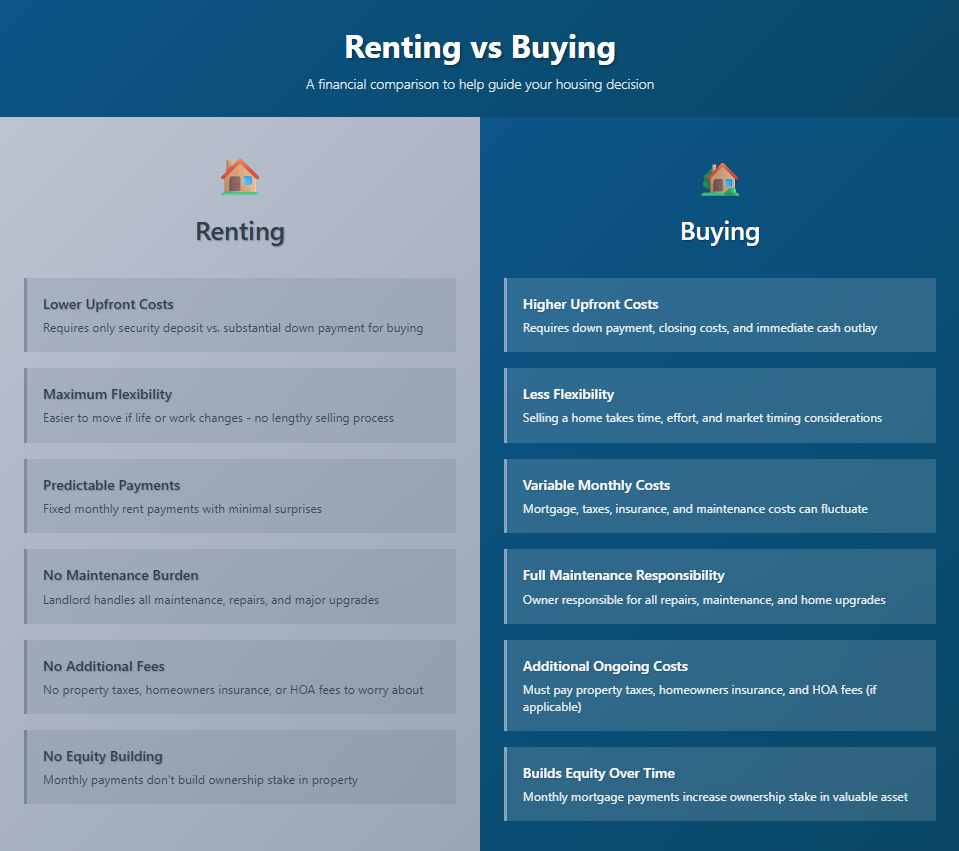
Suddenly, renting doesn’t sound so bad, does it? When something breaks, you aren’t on the hook to pay for it. With homeownership, these responsibilities are yours!
PSA: Owning a home isn’t automatically better than renting – it always depends on your situation. There’s a crowd that will die on the “renting is throwing away money” hill. Renting can provide flexibility, lower upfront costs, predictable expenses, and freedom from maintenance and property taxes. Owning, on the other hand, can help build equity, provide long-term stability, offer tax benefits, protect against rent hikes, and lets you customize your space. The right choice comes down to weighing the trade-offs for your stage of life and financial goals.

6. Don’t Try To Keep Up With The Joneses
Sometimes, I get the question, “What is the biggest mistake people make with their money?” My answer is always the same: “ Failing to live within your means. ”
Take time to understand your specific financial situation, and most importantly, buy within your means. That means making decisions based on your budget, your goals, and your lifestyle – not your neighbor’s, coworker’s, or Instagram feed’s.
As a gentle reminder: you usually only see the highlight reel of other people’s finances. You don’t know if that new car or luxury vacation was paid in full or financed with credit card debt or a HELOC. Don’t let peer spending pressure drive your decisions.
Trying to keep up with the Joneses can leave you in a cash pinch, or worse, quietly sacrificing your long-term financial success for short-term appearances.
Check in on what you value most – is it peace of mind, early retirement, financial freedom? Remember, buying a home “just because you can” isn’t the same as buying wisely.
7. You Can’t Control Interest Rates
Waiting until interest rates drop to purchase a house might seem like a good idea, but it’s probably not the best strategy. If you’re in a solid financial position and have found a home you truly like, don’t let “higher” interest rates be the sole reason you hold off. There’s no guarantee rates will return to prior lows – and trying to time the market could leave you waiting indefinitely.
For context, the average 30-year mortgage rate over the last 50 years has been around 7.68% – actually higher than today’s rates. It’s easy to fall into recency bias after the unusually low rates of the past 10-15 years, particularly during the COVID era.
The good news? If rates do come down, options like refinancing or recasting can help you adjust your mortgage down the road.
Buying a home is a major financial step, but it doesn’t have to feel overwhelming. By keeping these 7 financial essentials in mind, you can make decisions that align with your budget, your goals, and your life. A smart home purchase isn’t just about today – it’s about knowing you’ll be okay for years to come.
Johnson is a fee-only, fiduciary financial advisor with Asset Dedication LLC, DBA Branning Wealth Management. He provides hands-on, practical financial advice for millennials and young families. He is a board member of the Financial Planning Association of Mississippi.
Sources: 1 Freddie Mac, 30-Year Fixed Rate Mortgage Average in the United States [MORTGAGE30US], retrieved from FRED, Federal Reserve Bank of St. Louis; https://fred.stlouisfed.org/series/MORTGAGE30US, September 4, 2025.
Disclaimer : This blog is distributed for general informational purposes only and is not intended to constitute legal, tax, accounting, or investment advice. No part of this newsletter nor the links contained therein is a solicitation or offer to sell investment advisory services except where applicable in states where we are registered or where an exemption or exclusion from such registration exists. Information throughout this newsletter is obtained from sources that we believe reliable, but we do not warrant or guarantee the timeliness, accuracy, or completeness of this information, and the information presented should not be relied upon as such. The investment return and principal value of an investment will fluctuate. All investments involve risk of loss, including the possible loss of all amounts invested, and nothing within this newsletter should be construed as a guarantee of any specific outcome or profit. This newsletter may not be reproduced or redistributed in whole or in part. Any opinions expressed herein are those of the author and may not reflect the opinion of any affiliates. Furthermore, all opinions are current only as of the date of the distribution or publication and are subject to change without notice. Branning Wealth Management, LLC does not have any obligation to provide revised opinions in the event of changed circumstances.
The post 7 Financial Essentials to Know Before Buying a Home appeared first on Branning Wealth Management.