

The future is an amazing place. Had we told the world’s richest person in the 1800s that billions of people worldwide would be able to turn on a facet and have clean water or take a hot shower, or be healed from many infections with a simple pill or shot – they would be astounded. In fact, if they could, they would likely trade a substantial amount of their money for the everyday conveniences we are blessed to enjoy. Thankfully, there are so many ways our lives have been improving compared to humanity’s past. So, the future is an amazing place, right?
Some people are more prone than others to obsess about the future. It can be easy to get stuck living in the future – the what if’s or what could be. The infinite possibilities can become overwhelming. Getting stuck in thoughts about the future can create anxiety and fear because those events are part of the great unknown. A fundamental truth about the future is that it’s unknown, uncertain, and unknowable.
Let’s look at three approaches to use to make decisions about a portfolio: predictions, projections, or planning.
Predictions
2024 was a notable year for the U . S . stock market. The S&P 500 (500 largest companies in America) increased +23%. 2024’s 23% increase is more than double the index’s long term average of 10% since 1928. Each year, institutions make market predictions. But are predictions actionable? “ Read last year’s market predictions and you’ll never again take this year’s predictions seriously.” [1]
At the beginning of 2024, twenty of the largest financial institutions made their predictions for the year. The most optimistic institutions predicted that the S&P 500 would grow less than the long-term average, while the crystal ball for the majority saw a mediocre or worse scenario playing out.
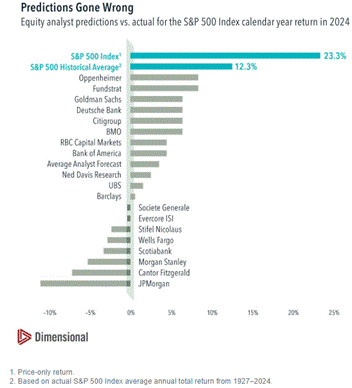
We are reminded by Peter Bernstein that “ Forecasts create the mirage that the future is knowable. ” Predictions are the least helpful at guiding a disciplined decision making process.
Projections
“ What’s past is prologue.” [2] Predictions and forecasts are flimsy, so what about projections? Projections are long-term focused calculations about the future that have roots in the past. Projections tell us something about where we are headed, a signpost.
Projections have been more directionally accurate than a single year forecast. A notable projection method tracks whether stock prices are high or low as compared to past periods using the median of all years.
Nobel prize winner, Professor Robert Shiller [3] , created the Cyclical Adjusted Price Earnings Ratio or CAPE10 [4] . The Shiller CAPE10, inflation adjusts price-to-earnings across the average of the last 10 years. This projection method unemotionally observes if the market is under, over, or at a fair value (e.g. the historical average of all years, or the last 30 or 50 years).
The observation is straightforward – “ when stocks are cheap, they can increase in price both from increasing corporate earnings and from an increasing price-to-earnings ratio on that figure. But when stocks are already expensive, and already have a high price-to-earnings ratio, they have a lot less room to grow and a lot more room to fall the next time there’s a recession or market correction. ” – Lyn Alden [5]
While projections of the value of the market using the CAPE10 ratio contain some information, it is still limited. The information offers insights into longer term directions. However, there is no information about the timing for a move in directions.
Projection tools like the CAPE10 are imperfect in timing, yet remain useful. CAPE10 can be helpful in framing future expectations about the most possible asset class directions over the coming decade. Projections, while imperfect, are better than predictions for making strategic long term portfolio decisions. [6]
Planning
Planning is different from making a predication. It is about embracing the unknown through goal matching. This process tests your portfolio goals across various time periods in the past. Intentional planning points out the areas that you can control – like your allocation decisions, savings or spending rates. Portfolio goals can be stressed tested through a range of possibilities and contingencies using imperfect, but helpful methods like an historical audit, monte carlo simulation, or through liability-matching (e.g. Social Security will cover some percentage of your essential expenses in retirement and a bond ladder can cover the difference).
Not everything that could happen actually does. Building a plan that considers a wide range of possibilities and contingencies that passes various kinds of tests can offer confidence into the unknown. The future will always present a new negative event. If a stress tested plan would have succeeded through market shocks in the past (e.g. The Great Depression), your plan, while not guaranteed, should be considered robust.
Building a personal plan can offer actionable guidance for the portfolio. The sequence of portfolio returns in the first ten years of retirement is particularly important. After stress testing, retirees can use projections like CAPE10 to help decide what percentage of the portfolio should be in stocks vs. bonds. If market values are historically high at the moment of retirement, tempering stock allocations may be considered, especially if the stress testing demonstrates high levels of historic success even with lower stock exposure.
Planning is a process that embraces future uncertainty through stress testing your cash flows and goals across the past. While past performance is not indicative of future results, planning allows you to visualize how your plan would have worked over your planning horizon through the worst in history.
Planning offers a personalized way to move forward with decisions about investing or striving toward a goal. We’d suggest avoiding predictions, using projections carefully, and above all, creating a plan for your future.
Charles Schwab reports that of the 96% of people with a written financial plan who are confident they’ll reach their financial goals, 76% say they’re more in control of their finances because of it. Financial planning allows you to set a measurable goal to work toward. [7]
Make a plan and go enjoy your life. Check in on the plan annually or as life events dictate. Planning helps you focus on the things you can control about today that will help you be ready for the future.
As originally featured in Northside Sun, February 2025 – Read full article .
By: Jason K. Branning, CFP®, RICP®. Jason is a CERTIFIED FINANCIAL PLANNER practitioner and Retirement Income Certified Professional®. He is the founder of Branning Wealth Management, a DBA of Asset Dedication, LLC, and specializes in retirement planning.
Disclaimer: This information does not constitute an offer to sell or a solicitation of an offer to buy any securities or investment strategy and is intended for informational purposes only. Investments are subject to market risk, including the loss of principal, and the investment strategies described may not be suitable for all investors. Equities are subject to market risk meaning that stock prices, in general, may decline over short or extended periods. The information contained does not take into account any investor’s specific individual investment objectives, particular needs, or financial situation. Nothing in this material constitutes investment, legal, accounting, or tax advice, or a representation that any investment or strategy is suitable or appropriate. Information in this report has been obtained from sources deemed to be reliable, and is not guaranteed. The above information is subject to change without notice.
Sources:
[1] The Psychology of Money: Timeless Lessons on Wealth, Greed, and Happiness. Morgan Housel. Harriman House. 2020.
[2] Shakespeare, William. The Tempest , Act 2, Scene I
[3] https://www.nobelprize.org/prizes/economic-sciences/2013/shiller/facts/
[4] http://www.econ.yale.edu/~shiller/data.htm
[5] https://www.lynalden.com/shiller-pe-cape-ratio/
[6] Investing Performance: Peaks and Valleys. Branning, Jason. Investments & Wealth Institute: Investment Monitor. December 2023.
[7] https://www.schwab.com/learn/story/5-ways-financial-planning-can-help#:~:text=Financial%20planning%20increases%20confidence,measurable%20goal%20to%20work%20toward.
The post Predictions, Projections, or Planning appeared first on Branning Wealth Management.